Start small and stay close
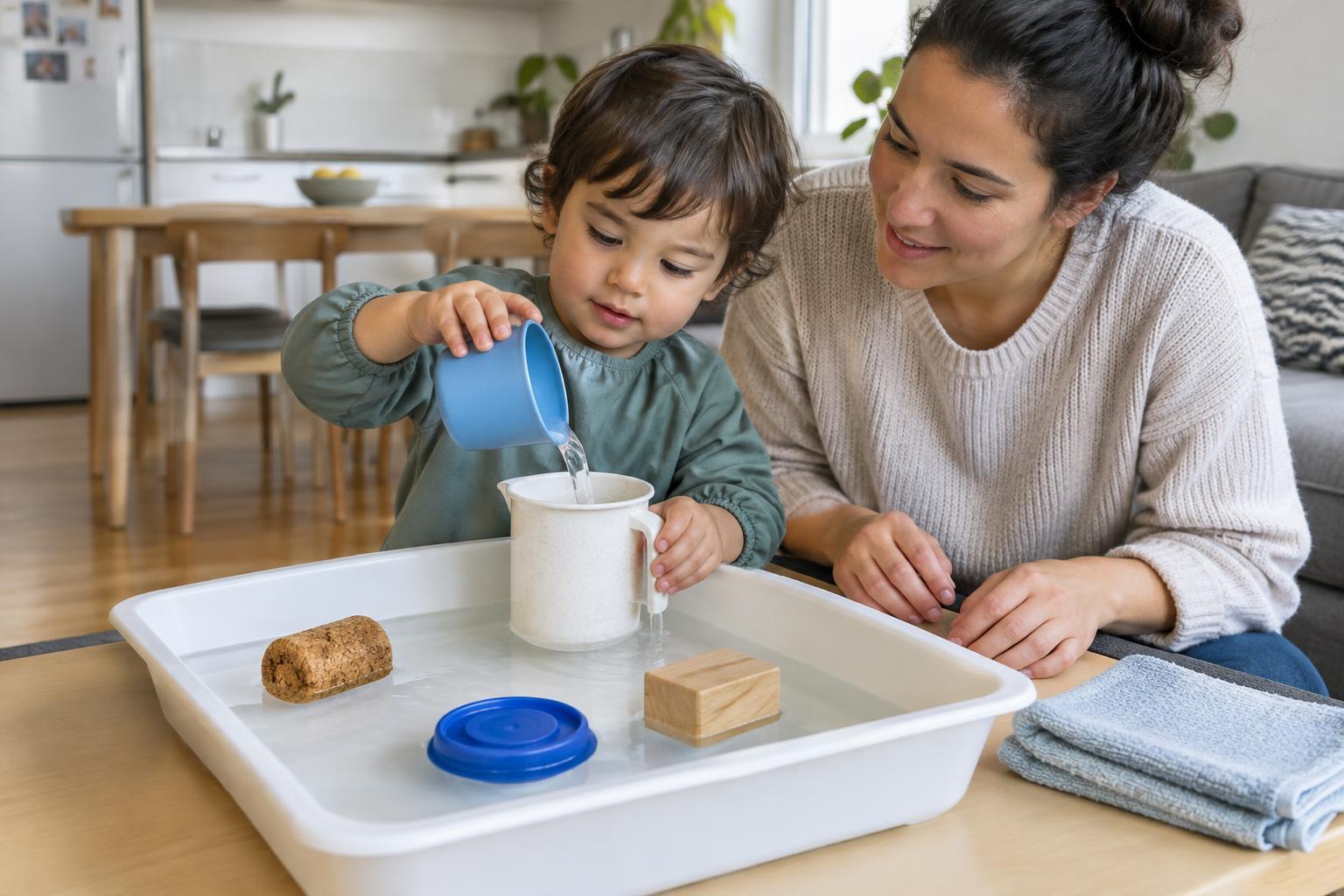
Water play does not need a bathtub, a special kit or a large amount of space. A shallow tray on a kitchen floor or a sturdy table can give a child room to scoop, pour and test what floats. Set a towel underneath, keep extra dry towels nearby and add only a small amount of water. A modest setup is easier to supervise and less daunting to clean up.
Stay within arm’s reach and watch actively throughout the activity. Young children can get into trouble around water quickly, even when the amount looks small. Empty containers as soon as play ends, and do not leave a filled tray or bucket out for later. Choose objects that are too large to be swallowed, skip anything sharp or breakable, and check household items for loose parts before offering them. If a child tends to put objects in their mouth, choose materials with that in mind.
Make a pouring station from everyday containers
Gather two or three lightweight cups, a small pitcher and a wide bowl. Place them in the tray, then invite your child to move water from one container to another. Different openings make each pour feel a little different: a wide cup empties quickly, while a narrow spout may take more care. You can ask, “Which one is easier to fill?” or “What happens if you pour more slowly?” There is no need to correct every spill; noticing where the water goes is part of the experiment.
For a variation, add a clean sponge or washcloth. A child can dip it, lift it and squeeze water into a bowl. Older children who want an extra challenge might try filling a container to a marked line or transferring water with a large spoon. Keep the choices few enough that the activity feels inviting rather than crowded. If the floor becomes slippery, pause to wipe it before continuing.
Try a floating and sinking investigation
Put a few water-safe items beside the tray, such as a cork, a large plastic lid, a metal spoon and a smooth stone that is too large to swallow. Before each item goes in, ask your child to guess whether it will float or sink. Then test it together. The point is not to get the answer right; it is to compare a prediction with what actually happens. Some objects may bob, tip over or float only when placed a certain way, giving you more to notice.
You can keep the conversation simple: “What do you see?” “Did it stay on top?” “What changed when we turned it over?” If your child wants to repeat the same test several times, let repetition be the activity. For another round, try placing a small water-safe item on a floating lid and see what happens. Avoid making broad rules based on one object—shape, material and whether an object traps air can all affect the result.
Follow the child’s questions
Water play often moves in a direction adults did not plan. A child may become interested in the sound of pouring, the way a sponge drips or how many spoonfuls fill a cup. Follow that interest with a short question or a chance to try again. Words such as full, empty, heavy, light, above and below can fit naturally into the conversation without turning play into a lesson.
It is also fine to let a child explore quietly. You might describe one thing you notice, then leave room for them to respond or keep playing. If frustration builds because a container is hard to handle, offer a steadier bowl or demonstrate one slow pour. Small adjustments can keep the experiment enjoyable while allowing the child to do as much as they can independently.
End with a simple reset
Give a brief warning before cleanup so the transition is not a surprise: “Two more pours, then we’ll empty the tray.” Pour the water away yourself or help your child do it safely. Invite them to place containers on a towel to dry and use a cloth to wipe the play area. The cleanup can be part of the routine, but the adult remains responsible for checking that the floor is dry and all water has been emptied.
On another day, the same tray can feel new with one small change: swap the sponge for a larger scoop, choose a different set of floating objects or move the activity to a suitable outdoor spot. Keeping the materials simple makes it easier to return to the play—and easier to give it your full attention each time.