Look for more than one way into a story
The best book for a mixed-age read-aloud is not necessarily one labeled for every child’s age. Look instead for a story that offers several points of entry. A younger child might enjoy repeated phrases, expressive pictures, or a funny character. An older child might notice a mystery, a surprising choice, or a joke tucked into the dialogue. Neither child has to experience the book in the same way for the reading time to belong to both of them.
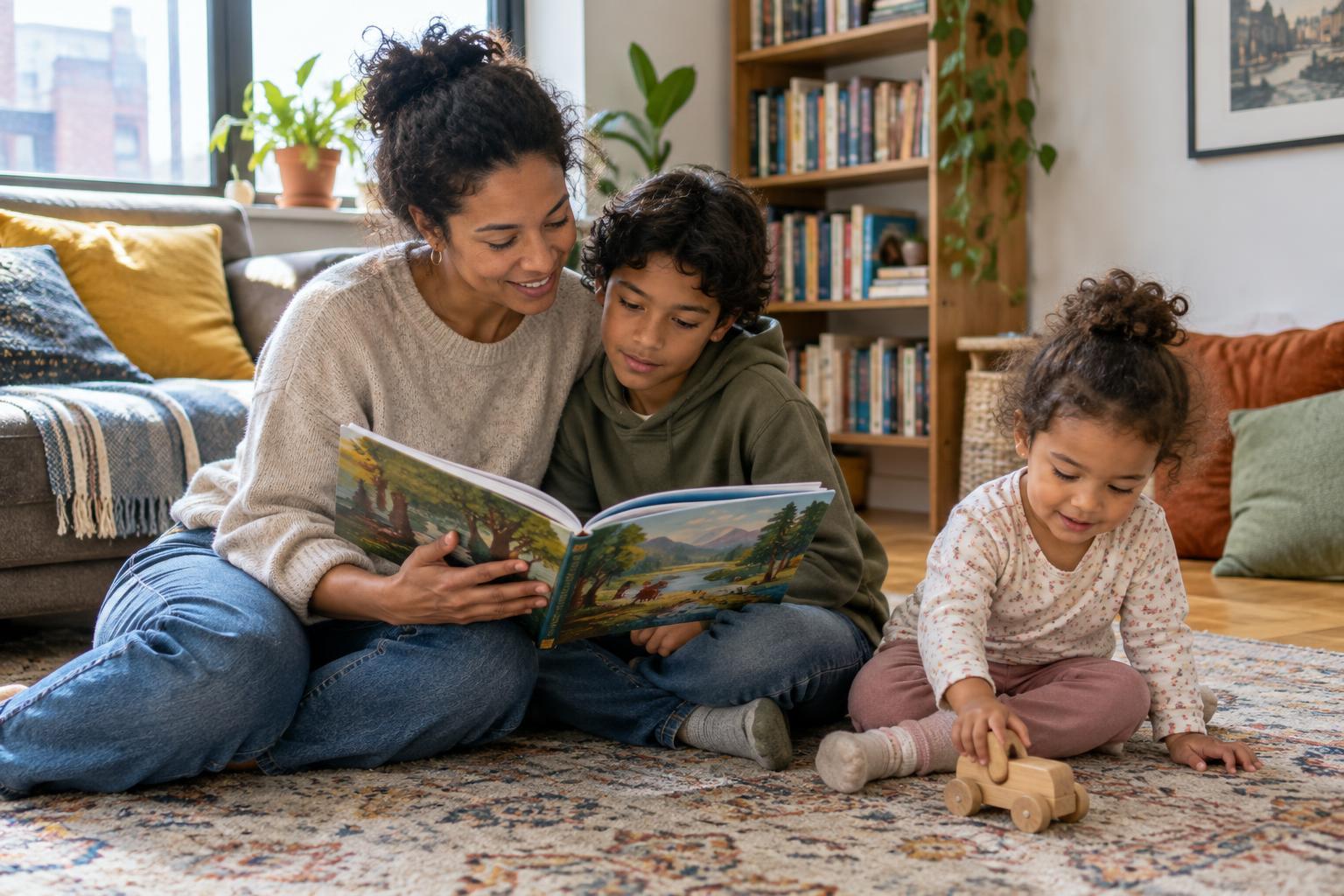
Picture books can work especially well, even when an older child usually reads chapter books independently. Rich illustrations give everyone something to examine, while a layered story gives older listeners room to make predictions or catch details. Short chapter books can also work if the plot is easy to reenter after an interruption. Before choosing a longer book, try reading the first few pages aloud to yourself: if the characters are hard to tell apart or the story needs a long explanation, it may be better saved for another time.
Let the book choice be a shared decision
A small, rotating stack makes choosing easier than searching a full shelf at bedtime. Gather a few possibilities from home or the library and let each child nominate one. You might alternate who gets the final pick, or agree to try a new book for one sitting before deciding whether to continue. That gives children a real voice without asking the whole family to negotiate every night.
Ask what each child likes about a candidate rather than whether it is “too young” or “too old.” One may want animals; another may want an adventure with a problem to solve. A book of folktales, poems, or connected short stories can be a useful compromise because each sitting has a natural stopping point. It is also fine to keep separate books in the mix. Shared reading need not replace one-on-one time with a book chosen for a particular child.
Make listening flexible
Listening does not have to mean sitting still. A younger child might draw, build quietly, or hold a soft toy while the story continues. An older child might prefer to stretch out nearby rather than sit shoulder to shoulder. In a small apartment, a blanket on the floor or a spot at the kitchen table can be enough. Choose a place where people can hear, not a setup that has to look perfect.
Keep participation invitations light. Pause now and then to ask what someone thinks might happen, or invite a child to supply a familiar repeated line. If an older child enjoys reading aloud, offer a page or a character’s dialogue, but let them decline. Avoid quizzing children to check whether they listened. A comment about a picture or a request to hear one part again is participation, too.
Build a ritual that can bend
A reliable read-aloud can be brief. Ten relaxed minutes after dinner, a few pages before bed, or one story on a weekend afternoon may fit better than a long session that competes with tiredness and chores. For a chapter book, stop at a clear moment and give a one-sentence reminder when you return: “They were about to open the gate.” On busy days, a poem or a single familiar favorite still counts.
Notice when the group’s attention shifts. If a book repeatedly loses one child, change the time, shorten the session, or set it aside without making anyone responsible for the problem. It can help to follow a longer story with a quick picture book chosen by the younger child, or to let the older child read ahead independently while keeping the family read-aloud as shared ground. The goal is not to finish a list of books. It is to make space for a story everyone is welcome to enter.