Start with one ramp and room to roll
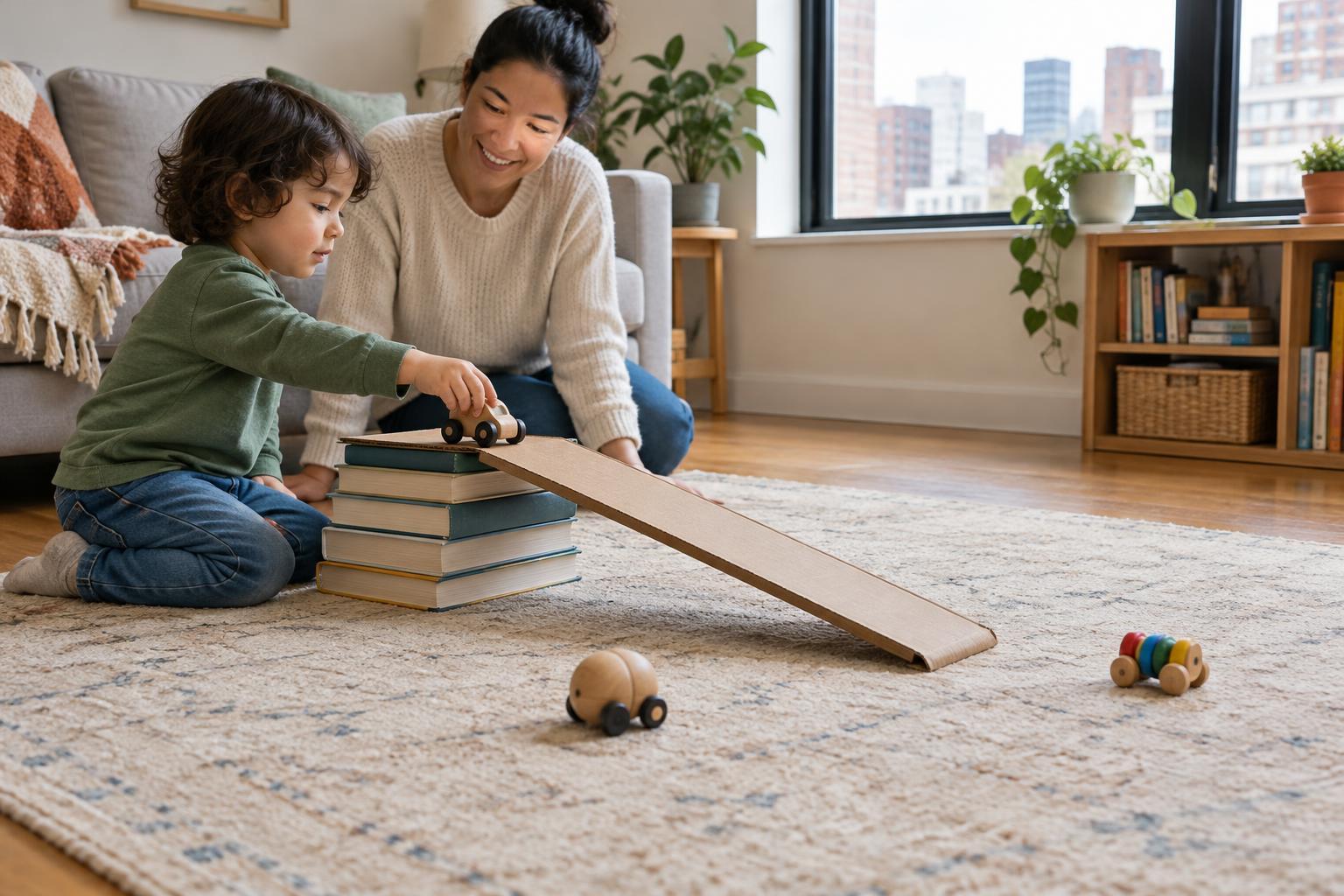
Ramp play does not need a kit or a long stretch of floor. A sturdy piece of cardboard, a shallow tray, or a book propped on a low stack of books can make a first ramp. Place it on the floor and aim it toward a clear landing area. A towel or soft mat at the far end can help keep toys from disappearing under furniture.
Choose a few toys that are easy for your child to handle, such as a toy car with secure wheels, a large ball, or a chunky cylinder. Check toys for loose parts and follow their age guidance, especially when younger children share the space. Keep the ramp low, supervise the activity, and move breakables out of the path. Once the setup is ready, let your child send one object down and watch what it does.
Make the first experiment simple
The easiest question is, “What happens when we let go?” Try placing a toy at the top of the ramp and releasing it without a push. Then do it again. It may roll straight, turn, stop partway, or keep going across the floor. Repeating a run gives children a chance to notice whether the result is similar or different.
When your child is ready, change just one thing. Raise the ramp slightly while keeping the same toy and starting spot, then compare the two runs. Or leave the ramp alone and try a different rolling toy. Changing one feature at a time makes the comparison easier to follow. There is no need to measure precisely: “It stopped near the rug” and “It rolled past the rug” are useful observations.
Follow curiosity with useful questions
You can support the play without turning it into a quiz. Before a run, ask, “Where do you think it will stop?” Afterward, try, “What did you notice?” or “What could we change?” If a prediction does not match what happens, treat that as an invitation to try again rather than a mistake to correct. Children may also enjoy showing you a result before they have words for it.
Pay attention to the ideas your child introduces. If they want to start halfway down the ramp, test that spot. If they notice a toy wobbling, invite them to compare it with one that rolls smoothly. A younger child might be happiest sending the same car down many times. An older child might want to arrange two starting lines and explain which run went farther. Both approaches make space for noticing cause and effect.
Add a challenge without adding clutter
A small collection of household items can extend the activity. Put a piece of fabric over part of the landing area and see how a toy behaves when it reaches the fabric. Make a wide target from a sheet of paper and try to get the toy to stop on it. Or place two low ramps side by side so children can compare them. Keep objects out of walking paths, and avoid using heavy items to prop up a ramp where they could tip.
If the toy veers off course, resist the urge to fix everything at once. Ask whether your child wants to straighten the ramp, move the starting point, or choose another toy. A few attempts can be more engaging than a perfect setup. For families in a compact home, limiting the game to one ramp and a designated landing zone also makes cleanup easier.
End by talking about what happened
When interest begins to fade, invite your child to show you a favorite run. You might say, “That car rolled farther when we raised the ramp,” or “The ball stopped sooner on the towel.” Simple descriptions help connect an action with its result without requiring a formal lesson. If your child disagrees, you can try another run together and see what happens.
Store the ramp with a small selection of toys so it is easy to bring out another day. A later session can begin with a question your child remembers: Will the same toy travel as far from a lower starting point? Familiar materials leave room for new ideas, and the play can last as long—or as briefly—as your family’s routine allows.