Start with a question, not a number
Which is longer: a book or a placemat? How many blocks long is a windowsill? Questions like these invite children to make a guess, test it and talk about what they notice. You do not need a ruler or a prepared activity. Choose two objects nearby and ask your child to place them side by side, lining up one end of each. That shared starting point makes the comparison easier to see.
When objects cannot be moved, a third object can help. Lay a piece of string along the edge of a table, mark where the edge ends with your fingers, and carry the string to a shelf. Is the shelf longer or shorter than the marked length? Let your child suggest what to compare next. The conversation matters as much as the answer: “How can we check?” is often more useful than “Which one wins?”
Use hands for small spaces
A handspan—the distance between an outstretched thumb and little finger—makes a convenient measuring tool for a tabletop, cushion or book. Show your child how to place one handspan after another without leaving gaps or overlapping. For a smaller object, they can try finger widths instead. Before counting, ask for a prediction: will the book be more or less than two handspans wide?
A child’s handspan and an adult’s handspan will usually give different counts for the same object. Try measuring a cushion with each person’s hand, then compare results. The cushion has not changed; the measuring unit has. If the counts seem surprising, repeat the measurement together and check where each handspan begins and ends. This keeps an imperfect attempt part of the game rather than something to correct immediately.
Take steps across a room
Steps work well for longer distances, such as the length of a hallway or the space from a doorway to a sofa. Pick a clear route and agree on a start and finish. Count ordinary walking steps together, then try again with short steps. The second count will probably be larger. Ask your child why that might happen, and invite them to demonstrate the difference.
You can take the same idea on a familiar outing: count steps between two benches or across a safe, open stretch of path. Treat the count as an estimate, especially if someone changes pace or walks around an obstacle. If you want to compare two routes more fairly, have the same person take similarly sized steps on both. The goal is not perfect precision; it is noticing how the method affects the result.
Build a length with blocks
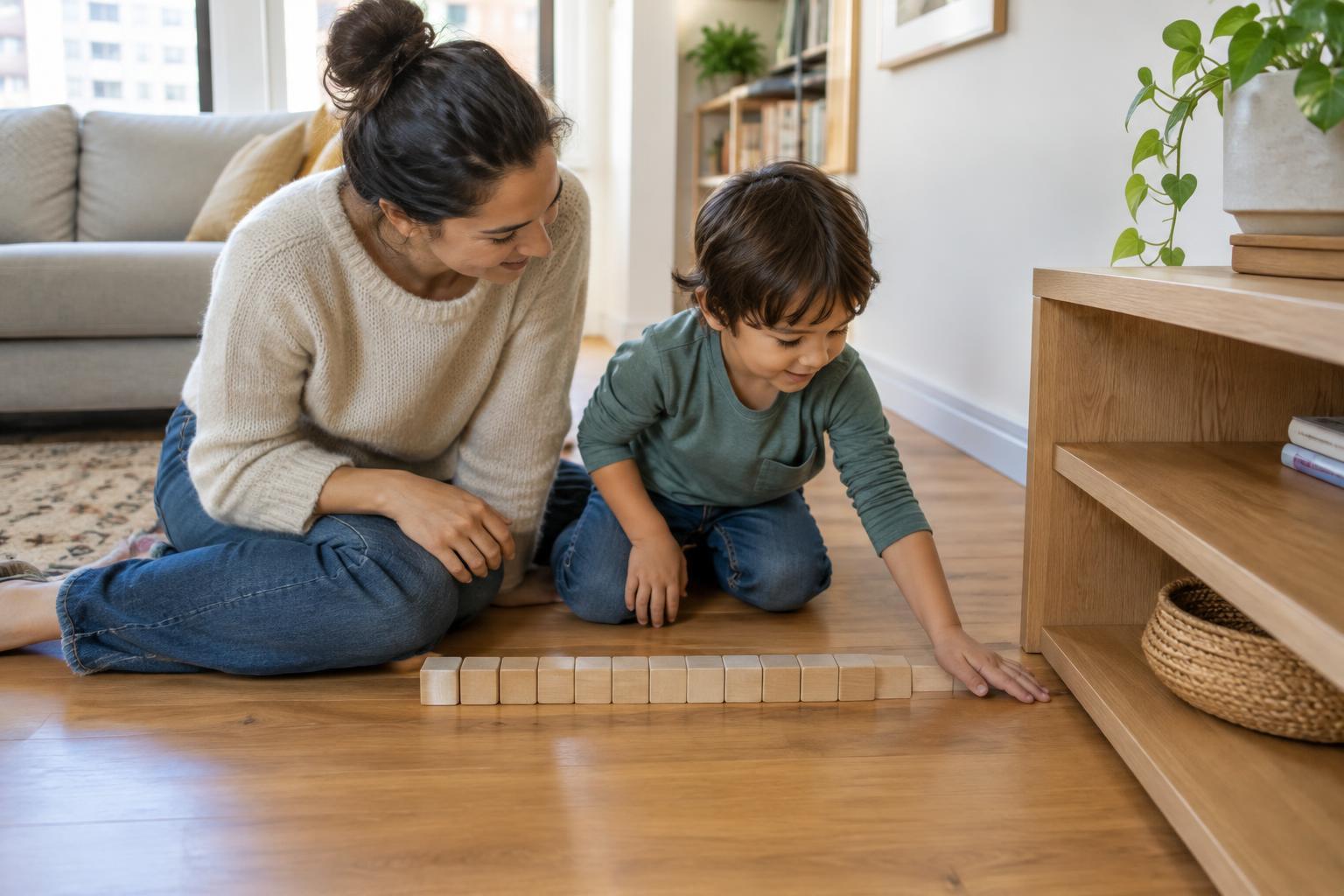
Blocks offer a unit children can see and rearrange. Place identical blocks in a straight row along the edge of a book or tray. Encourage your child to push the blocks together without stacking them and to begin at the object’s end. Count the row, then use those same blocks to measure something else. Which object takes more blocks? How many more?
Sometimes an object ends partway through a block. You can call it “a little more than four blocks” rather than forcing an exact count. Mixing large and small blocks creates another question: can two objects be compared by block count if the blocks are different sizes? Let your child test the idea by measuring one object twice. Keeping the blocks the same size makes the counts more useful for comparison.
Make room for guesses and discoveries
Keep the activity short enough to fit the moment. A few minutes while clearing a table or putting toys away can be plenty. Invite your child to choose an object, guess its length in handspans or blocks, and check. For a playful challenge, ask them to find something that is about five blocks long or shorter than three handspans. “About” leaves room for objects that do not fit a whole number of units.
When you revisit a measurement, use the same unit and starting point if you want to see whether your results agree. If they do not, look for a gap, an overlap or a change in step size before counting again. Over time, these small experiments give children a practical reason to line things up, count carefully and explain their thinking—all with materials already close at hand.