Start with the kind of match your child can see
A matching game does not need a box of cards or a long set of rules. Placing two socks together, finding a toy that looks like a picture, and turning over cards to find a pair all invite a child to notice what is alike. The difference is how much they must keep in mind. When both choices are visible, a child can look back and forth. When cards are face down, they also need to remember where they saw each one.
Begin with a few clear choices and a goal your child can understand: “Can we find the other yellow cup?” Sit alongside them and describe what you notice without demanding a quick answer. If the match is easy, add another pair or change the rule. If interest fades, simplify it or stop. A short game that ends pleasantly is more useful than one everyone feels obliged to finish.
Use objects for a hands-on first round
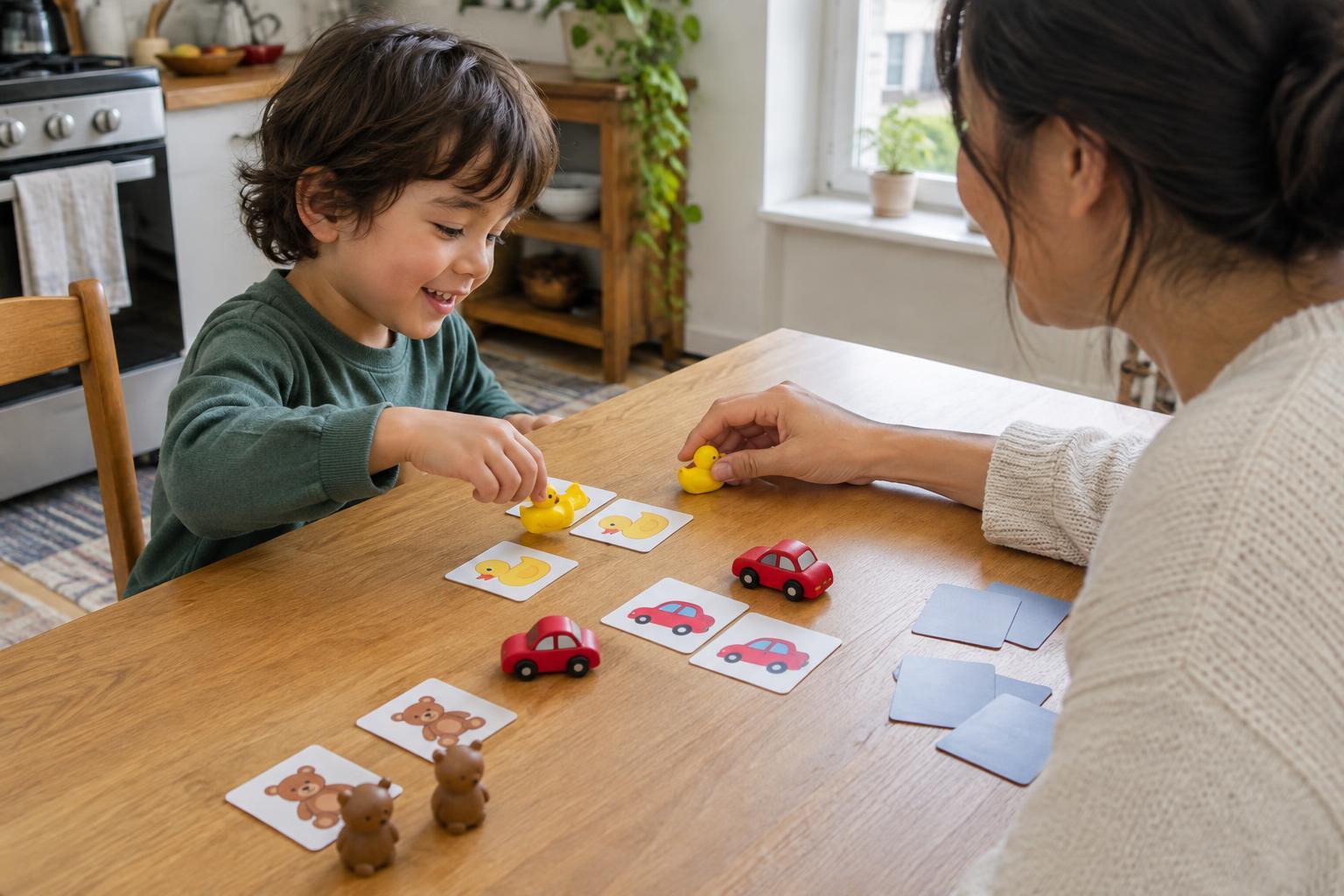
Objects make the idea of “same” easy to explore because children can pick them up, turn them around and put them side by side. Try pairing identical blocks, spoons or toy vehicles. Set out two or three pairs in a small space, such as a tray or cleared corner of the table, so the choices are easy to see. Choose items that are safe for your child to handle, and put away anything small enough to be a concern.
Once identical pairs feel familiar, invite a different kind of match: a spoon with a bowl, a shoe with its partner, or items of the same color that are otherwise different. Say the rule out loud before you begin. “This time we’re finding things that go together” is a different challenge from “Find one exactly like this.” Sorting the objects into little groups can be the whole activity; there is no need to add winners or points.
Try pictures when you want more variety
Picture cards are convenient when you want to bring the game to a café table, a waiting room or a relative’s home. Photos of familiar things can be easier to recognize than busy illustrations, especially when a child is new to the game. Start by laying the cards face up and asking them to find two that are the same. You can make simple pairs from printed pictures or use a deck you already own.
Pictures also let you explore relationships that cannot fit on the table. Match a picture of a bus to another bus, or pair an animal with a picture of where it lives if your child enjoys that idea. Keep the rule consistent for each round so the game stays clear. If your child calls two pictures a match for a reason you did not expect, ask what they noticed. Their explanation may lead to a better conversation than correcting the pair immediately.
Save face-down memory cards for a new challenge
Memory cards add a step: players turn over two cards, then try to remember their locations if they do not match. To make that manageable, begin with just two or three pairs and arrange them in neat rows. Turn the cards over slowly, name what you see, and put unmatched cards back in the same spots. A consistent layout makes it easier to follow the game than a scattered pile.
You can play cooperatively, with everyone working to find all the pairs, rather than keeping score. Give your child time to point or think aloud before the next turn. If they prefer to leave the cards face up, play that way. It is still a matching game, and it may be the version they enjoy today.
Let the game fit the moment
The best format is the one that works for your child and the time you have. Objects invite touching and moving; pictures travel easily; memory cards add the fun of a reveal. For a quick reset between errands or household tasks, one round with a handful of pairs may be enough. You can store a few cards in an envelope or keep a small collection of matching objects in a container for another day.
Watch for signs that the challenge needs adjusting. Repeated guesses may mean there are too many choices, while a child who finishes instantly might enjoy a new matching rule. Let them take a turn setting up the pairs or inventing the rule, too. Matching games work best as shared play: a chance to look closely together, make discoveries and enjoy the occasional surprising match.