Start with the dishes that earn their space
In a small kitchen, the easiest way to make room is to decide what needs room in the first place. Gather children’s plates, bowls, cups, and utensils from every cabinet, drawer, and drying rack. Set aside anything that is damaged, difficult to clean, or rarely used. Then look at a typical day: which pieces do you actually reach for at breakfast, snacks, and dinner?
Keep a working set that fits your household’s habits rather than every dish you own. A few dependable pieces may be more useful than a tall stack of mismatched extras. If you keep spare dishes for visiting children or occasional outings, store those separately from the everyday set. This leaves the most convenient space for items that need to come out and go back several times a day.
Notice how the dishes behave in storage, too. Plates with similar shapes tend to stack more neatly, while cups that nest without sticking can take up less shelf space. There is no need to replace usable items just to make a matching set. The goal is to see what you have clearly and avoid moving a pile of things to reach one spoon.
Choose one practical home base
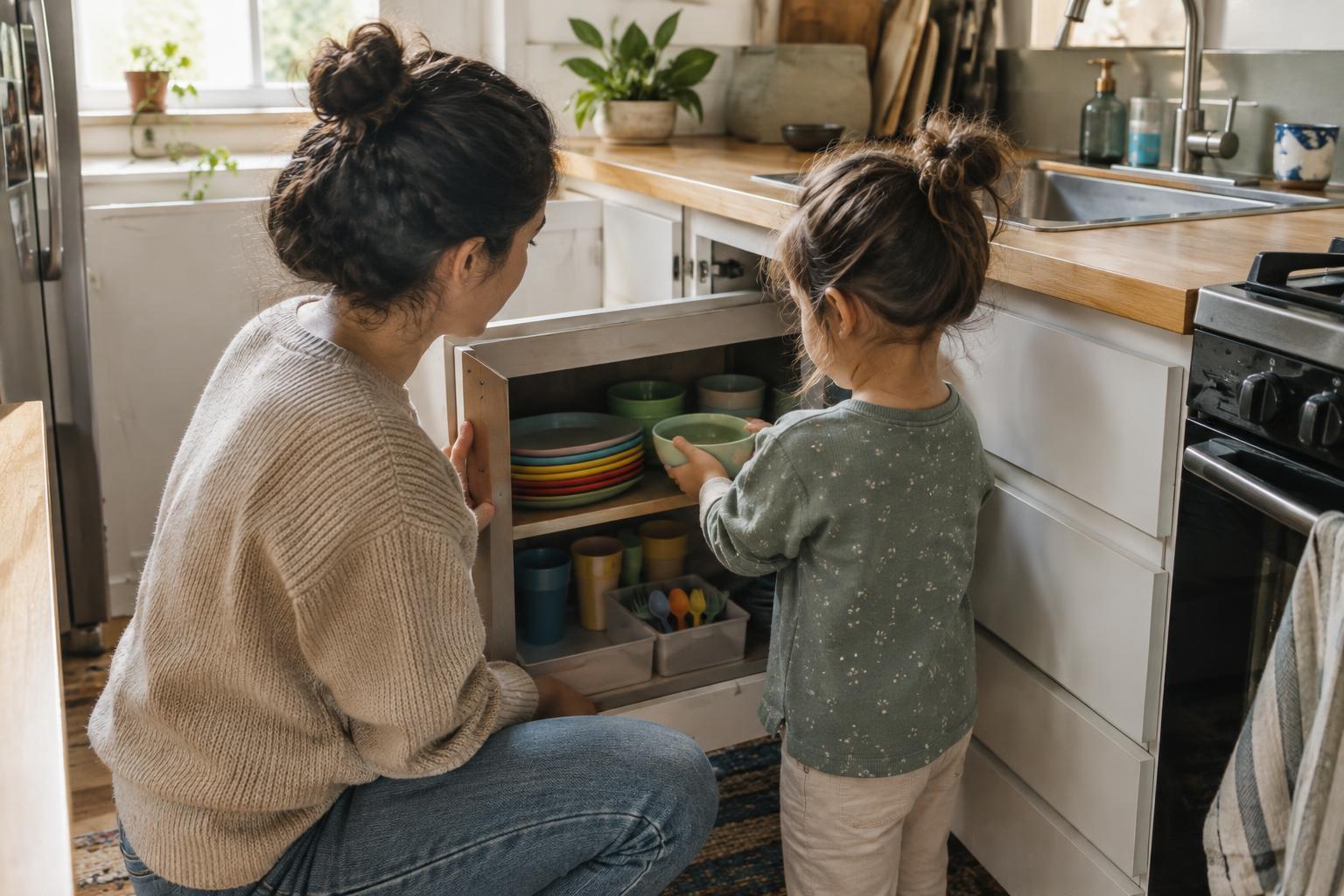
A single home base makes a compact kitchen easier for everyone to use. Depending on the layout, that might be one low cabinet shelf, part of a drawer, or a bin on an open shelf. Choose a spot near where you prepare or serve food, if possible, so putting dishes away does not require crossing a busy kitchen. If children will get items themselves, consider whether they can reach the spot without climbing.
Keep the setup simple. A shallow bin can hold small plates upright; a drawer divider can stop spoons and forks from spreading across a drawer. If a cabinet has a deep shelf, place the most-used items at the front instead of adding organizers that make the space harder to navigate. Leave enough clearance to lift out a cup without knocking over a stack.
A reachable spot should also be a sensible spot. Keep sharp utensils, cleaning products, and heavy or fragile items in separate storage appropriate for your household. Children’s access can change as their skills and your kitchen routines change, so the arrangement does not have to be permanent. The useful test is whether the dishes can be retrieved and returned without creating a new obstacle in the room.
Make the system easy to reset
Even a tidy cabinet can become crowded when clean dishes have no obvious destination. Give each type of item a small zone: cups together, plates together, utensils in one section. You can use a simple label or a picture on a bin if that helps family members return things to the right place. Avoid dividing the space so finely that putting away a load of dishes becomes a sorting project.
Think through the full trip each item takes. Where do used dishes land after meals? Where do they dry? Can someone carry them from the dishwasher or drying rack to their home base in one short step? If clean cups routinely collect on the counter, their assigned space may be too full or inconvenient. Adjusting the storage spot is often more effective than reminding everyone to keep the counter clear.
Children who want to help can take on a manageable part of the reset, such as placing dry spoons in a drawer or stacking lightweight plates. Show them where the items belong, then keep the routine consistent. Participation may take longer at first, but a clear, repeatable task is easier to share than a cabinet that changes every week.
Protect the little bit of space you gained
Small kitchens fill up gradually. Party cups, extra snack containers, and new utensils can slip into the everyday area until it is crowded again. Before adding something, check whether it serves a purpose your current dishes do not. When the home base starts to overflow, take a few minutes to remove items that have stopped being useful rather than finding a second location for the same category.
The best arrangement is not necessarily the most elaborate one. It is the one that makes ordinary meals smoother: a child can find a cup, an adult can reach a plate, and clean dishes have somewhere to go. Start with one shelf or drawer, use it for a week or two, and change what gets in the way. In a small kitchen, that modest bit of breathing room can make the whole routine feel simpler.