Start with a small, reachable collection
The easiest art supplies to put away are the ones that have an obvious home. Before buying bins or rearranging a shelf, gather what your family already uses and set aside dried-out markers, scraps too small to be useful and projects you are ready to recycle. Then choose a modest everyday collection: perhaps paper, crayons, washable markers, glue sticks and a few favorite tools. Extra supplies can live elsewhere until they are needed.
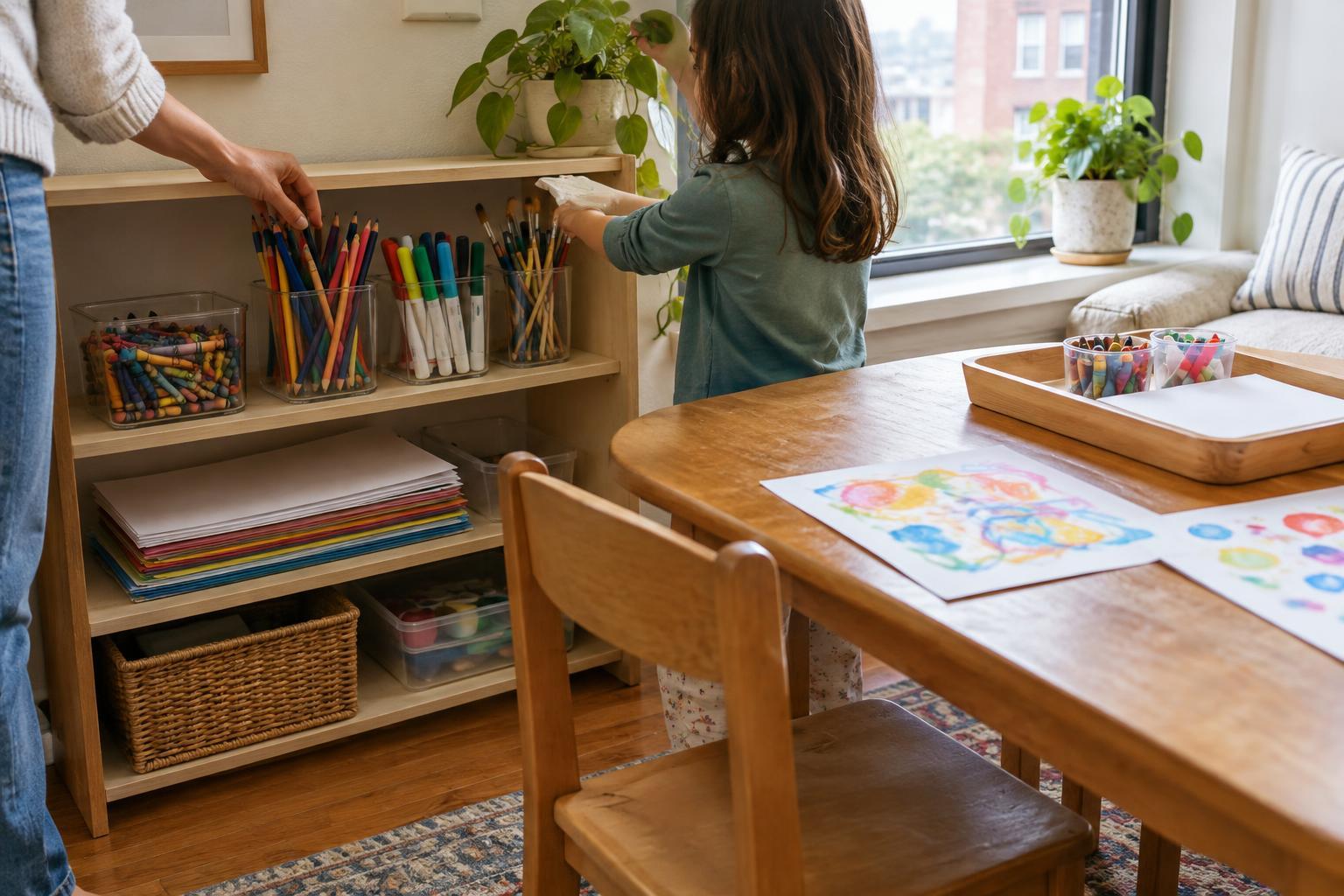
Give the everyday collection one low shelf, drawer or rolling cart that children can reach without climbing. Keep heavier items near the bottom, and check that any furniture or cart is stable. Supplies that need closer adult involvement, such as sharp scissors or materials with small pieces, can go on a higher shelf. Reachable storage works best when it matches what each child can use safely and reasonably put away.
Give each type of supply a visible home
Broad categories are easier to maintain than an elaborate sorting system. One container for drawing tools, one for paper and one for collage materials may be enough. Open cups or shallow bins let children see what is available; lids can be useful for keeping dust out, but they add a step at cleanup time. Choose containers children can lift and carry without spilling.
Labels help everyone return things to the same place. A word paired with a simple drawing works for a household with readers and nonreaders. If several children share the space, label by supply rather than by owner unless personal materials truly need separate storage. Leave a little room in each container so putting things back does not feel like a packing puzzle.
Paper often becomes the biggest source of clutter. Keep blank sheets together in a tray or magazine file, and provide a second spot for usable scraps. A folder or flat box can hold work in progress. When that box fills, it is a natural prompt to finish, display, photograph or let go of some pieces rather than adding another pile.
Make the work area easy to reset
Store supplies as close as practical to the place where children make art. In a small home, that might be a kitchen table with a portable caddy nearby rather than a permanent art corner. A wipeable mat or reusable table covering marks out the workspace and catches stray glue or paint. Keep a cloth, wastebasket and scrap-paper container within easy reach so cleanup does not require a trip across the room.
Set a simple boundary for each session: take out one bin at a time, or choose the materials that fit on the mat. This is not about limiting creativity; it keeps the number of loose items manageable. For messier activities, set out the needed supplies together and plan for an adult to help with the reset. If cleanup repeatedly feels too big, try offering fewer materials at once before changing the entire storage setup.
Build a cleanup routine children can follow
A repeatable sequence is more useful than a vague request to tidy up. Try: cap the markers, put tools in their containers, move artwork to the drying or in-progress spot, collect scraps, then wipe the table. A quick verbal reminder or a picture list beside the shelf can help children remember what comes next. Younger children may need someone to do the steps alongside them; the goal is a routine they can participate in, not a perfect result.
Make the final check small and concrete. Ask, “Is every marker capped?” or “Is the table clear enough for our next meal?” rather than reopening the whole project. When art happens during a busy part of the day, allowing a designated in-progress tray can be more realistic than expecting every creation to be finished and filed immediately.
Adjust the system as your family uses it
Watch where supplies naturally end up. If crayons are always left on the table, they may need a tabletop cup instead of a drawer. If the collage bin regularly overflows, offer a smaller selection and keep the rest in reserve. A storage system is working when children can find supplies and most items have a straightforward path back home.
Every so often, empty the containers, remove what is no longer useful and make space for current interests. You do not need to preserve every drawing to value the time spent making it. A reachable collection, a clear place for works in progress and a short cleanup sequence can make art easier to start—and easier to welcome back tomorrow.