Start with the town you already have
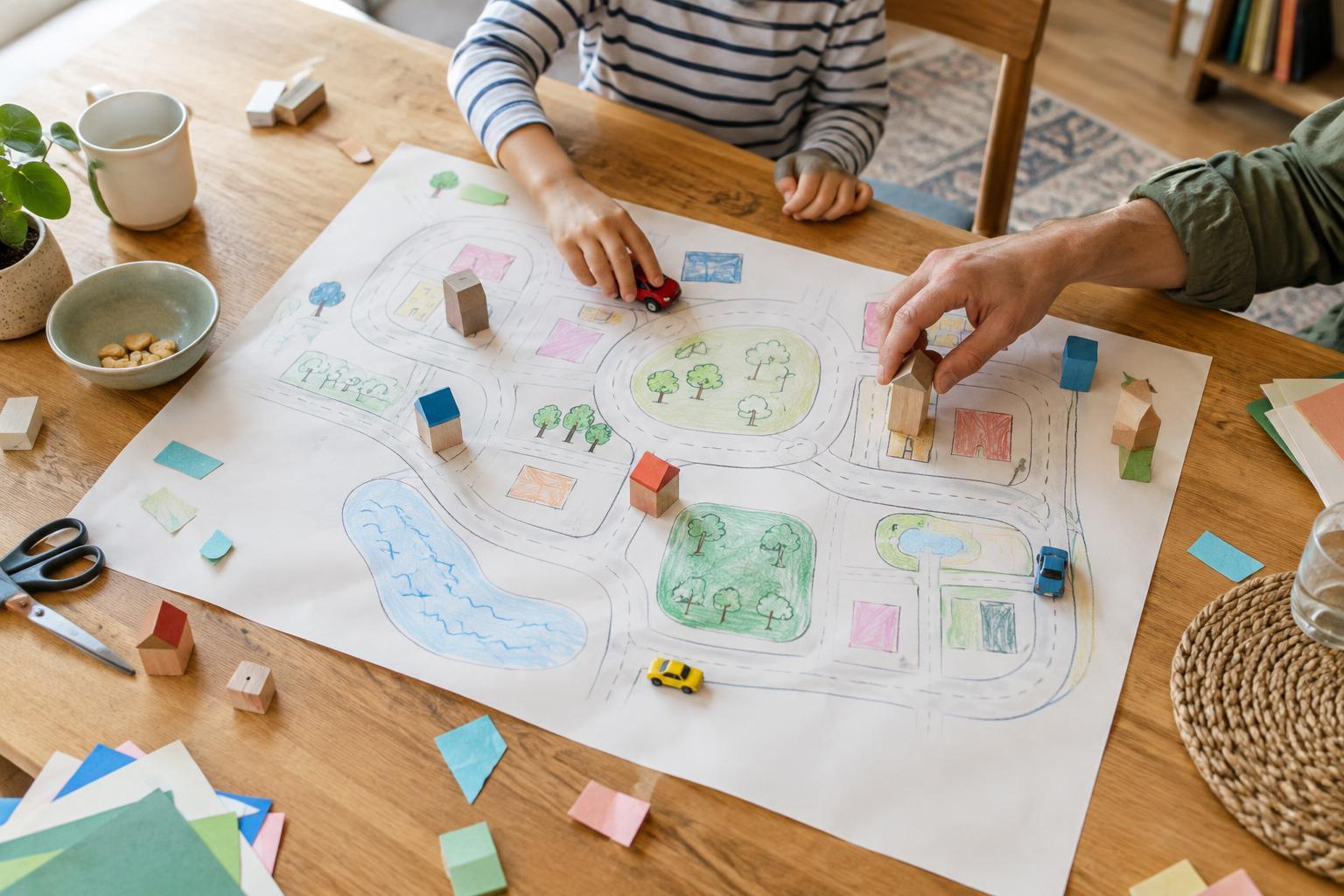
A pretend town does not need a detailed plan. Spread a large sheet of paper on a table or the floor, or tape together a few smaller sheets. Gather washable markers or crayons, plus whatever might become buildings: blocks, small boxes, paper cups or folded pieces of cardboard. Toy people and vehicles are welcome, but fingers can do the traveling just as well.
Ask one simple question to begin: “Where should we go first?” A child might choose a bakery, a park, a library or an entirely invented place. Draw that spot together and give it a name. Then add a home base and a path between the two. Those three marks are enough to start playing. Leaving blank space gives the town room to grow instead of making the map feel like a project that must be finished before anyone can have fun.
Let places lead to stories
As new places appear, invite the child to decide what happens in each one. Who works at the pretend shop? What can visitors do at the park? Is there a quiet corner where a tired bus driver can rest? Everyday places can be recognizable without being realistic. A school can sit next to a castle, and a bridge can cross a river made from a blue scarf.
Try following the action rather than directing it. If a toy animal needs to deliver a package, ask where the package starts and where it needs to go. If a road stops at the edge of the paper, the town can gain a new street or an imaginary tunnel. These small decisions give everyone a reason to return to the map. They also make drawing and arranging objects part of the game, not a separate task.
Children who do not want to draw can place objects while someone else makes marks. A caregiver can write labels if requested, or use simple pictures instead. There is no need to correct the scale of a building or straighten a road. The map only has to make sense to the people playing with it.
Use the map to explore routes
Once the town has a few destinations, send someone on a short trip. Move a finger, figure or toy car from home to the shop. Trace the route and describe it in ordinary language: “We pass the park, turn by the tall building and stop at the shop.” Then let the child choose a different way home. If the trip becomes a story about a traffic jam or a surprise visit, follow that story.
For a gentle challenge, add a reason to plan a route. Perhaps the bakery has bread to deliver to two houses, or a visitor wants to see the pond before going to the playground. Draw a crossing, add a landmark or make one path temporarily closed. You can ask, “What could we try now?” without requiring one correct answer. If several people are playing, take turns choosing destinations and explaining how to get there.
A small town can also grow upward. Stack blocks on the paper for tall buildings, use a box as a station, or place a scrap of fabric over two blocks to make a covered walkway. Moving between the flat drawing and the standing objects helps keep the game lively, especially when there is not much space to spread out.
Make it easy to pause and return
A pretend town works best when it fits the time and space available. For a quick session, draw just one street and three stops. For play that lasts across several days, leave the paper somewhere safe or take a photo before clearing the table. Loose buildings can go into a small container, ready to be set out again. If the map gets crowded, tape on another sheet rather than starting over.
When interest shifts, the town can shift too. A rainy-day game might become a town-wide parade; another day, everyone might visit a newly drawn garden. Invite children to rename places, erase a route if the materials allow it, or build a second town nearby. The goal is not a polished map. It is a shared space where a few lines and objects help everyone imagine what happens next.