Set the boundaries before asking for ideas
Inviting kids to help plan can build excitement, but an open-ended question like “What should we do today?” may produce ideas that do not fit the time, budget, weather, or energy available. Before starting the conversation, decide what the adults can realistically offer. Perhaps the family has two hours, needs to stay close to home, and wants to keep costs low. Those limits are not a rejection of anyone’s ideas; they are the shape of the plan.
Share the boundaries in simple language: “We have the afternoon free, and we’re choosing something we can get to easily.” If a child suggests a bigger outing, acknowledge it without reopening the whole day: “That sounds fun. It doesn’t fit today, but we can keep it on our ideas list.” This leaves room for imagination while making clear that the choice is about today’s activity.
Offer a short menu of workable choices
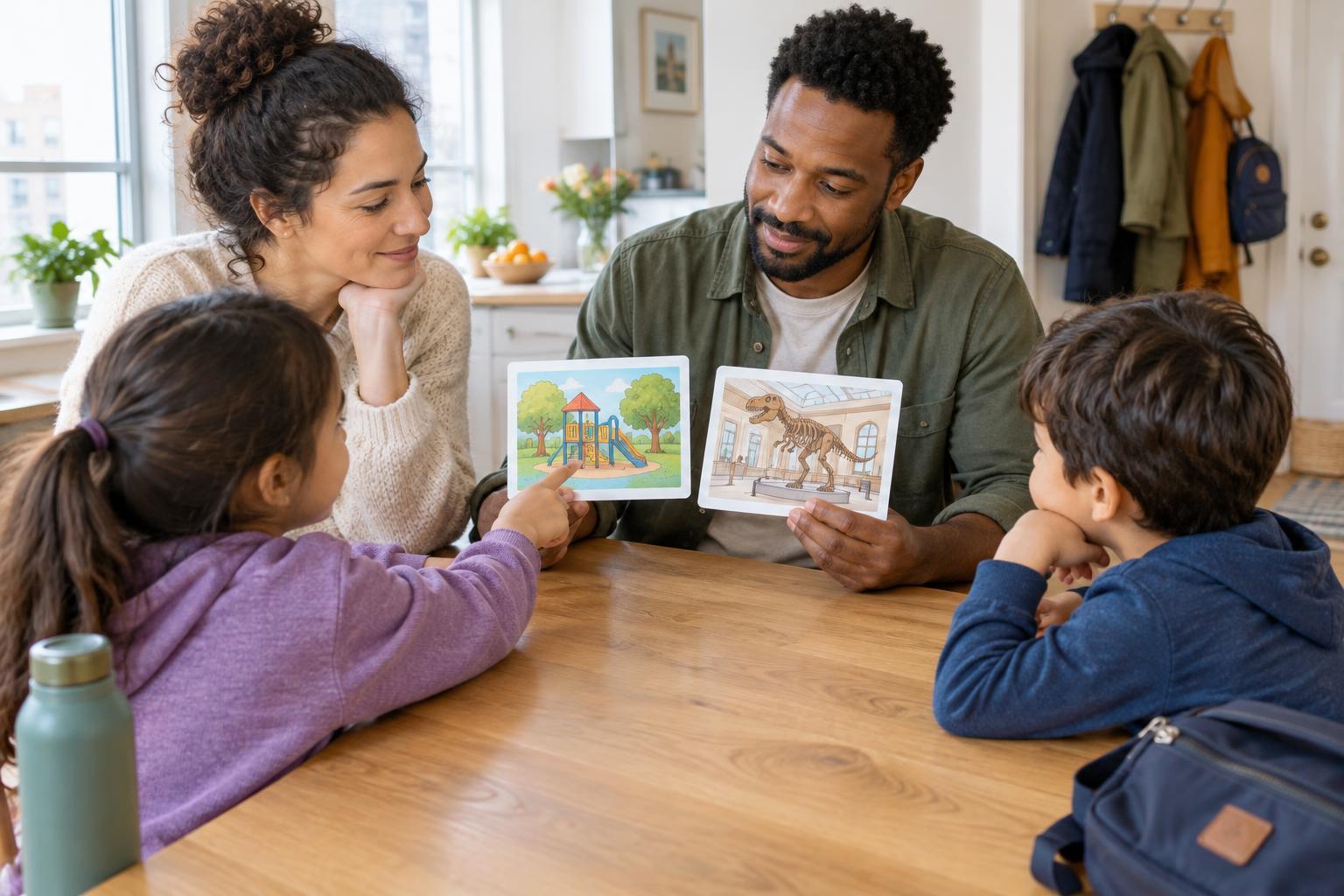
Two or three options are usually easier to discuss than an unlimited list. The choices can still feel distinct: a playground visit, a library trip, or a family game at home, for example. Try to offer only activities you would actually be willing and able to do. If the family cannot stay out late, a long trip across the city should not appear on the menu just because it sounds appealing.
Kids can help shape an option without controlling every detail. A younger child might choose which game to bring to the park; an older child might compare two nearby places or suggest what to pack. If there is time to plan ahead, invite everyone to contribute ideas to a family activity list. Adults can then pull suitable options from that list when a free afternoon arrives.
Choose a decision rule before opinions collide
When more than one child is involved, disagreement is normal. Decide how the family will choose before hearing everyone’s favorite. You might take turns picking from the menu, let one child choose the destination and another choose a snack to bring, or use a quick vote when all the options work equally well. No method guarantees that everyone will be delighted, but a predictable process can keep the discussion from becoming a contest over who argues longest.
Be clear about what the decision means. “Today, Maya picks from these two activities. Next time, it’s Eli’s turn” is easier to understand than a vague promise that someone else will choose later. For a vote, explain whether the most popular option wins or whether the adults will make the final call if there is a tie. The rule matters less than applying it consistently and kindly.
Close the choice, then make room for feelings
Once the activity is chosen, say the plan out loud: “We’re going to the library, and we’ll leave after lunch.” A child can be disappointed without the decision needing to restart. You can acknowledge the feeling—“You really wanted the playground”—and offer a small choice within the settled plan, such as which books to look for first. This gives the child a way to participate without turning every step into another negotiation.
Plans sometimes need to change because of rain, a closed venue, or a tired family member. It helps to name a backup in advance: “If we can’t go outside, we’ll build a blanket fort at home.” For busy city days, a short activity can be a complete family plan; it does not need to fill every hour. Afterward, ask one easy question, such as “What should we do again?” The answer can guide a future outing, when the family is ready to choose again.