Start with your space, not a shopping list
An indoor scavenger hunt does not need prizes, printed cards, or a house full of hiding places. A few familiar objects and a clear place to play are enough. Before writing clues, decide which rooms or corners are in bounds. In a small apartment, the hunt might stay in one room; in a larger home, it can follow a short route from room to room. Keeping the play area defined makes it easier for everyone to know where to look.
Walk through that area and pick five to eight things players can safely find or observe: a pillow, a spoon, a book with an animal on the cover, a pair of shoes, or something that makes a gentle sound. You do not have to hide every item. Spotting a familiar object from a new clue can be just as satisfying as finding a tucked-away note. Choose objects that are easy to reach without climbing, opening private drawers, or moving heavy furniture.
Choose one simple way to play
For the quickest version, call out a description and let everyone point to or bring back a matching object: “Find something soft,” “Find something round,” or “Find something we use at breakfast.” If several children are playing, pointing rather than collecting can keep the room from becoming a pile of household belongings. Set a comfortable pace and make it clear that walking feet are part of the game.
For a clue trail, place a short note beside each chosen object. The first clue leads to the pillow, the note by the pillow leads to a book, and so on until players reach a final message. That message can simply say, “You found them all!” A shared activity, such as choosing a story to read, works well as an ending if you want one. Write the trail down in order before placing the notes so you can check that no clue leads to a dead end.
Make clues that invite looking and thinking
Good clues give players a way to notice an object without requiring them to guess what is in an adult’s head. For a spoon, try, “I help you eat soup, but I am not a bowl.” For a pillow: “I am soft and wait where you rest.” You can also use color, shape, texture, or location: “Look for something blue near the place we keep our books.” If a clue seems too hard, offer a second hint rather than revealing the answer immediately.
Match the task to the players. Younger children may enjoy picture clues, simple categories, or searching with a partner. Older children might like a two-part clue, such as finding something made of paper that shows a place. Invite them to write a clue for the adults once they understand the game. There is no need to make every clue difficult; alternating easy finds with trickier ones helps the hunt keep moving.
Adapt the hunt to your family’s energy
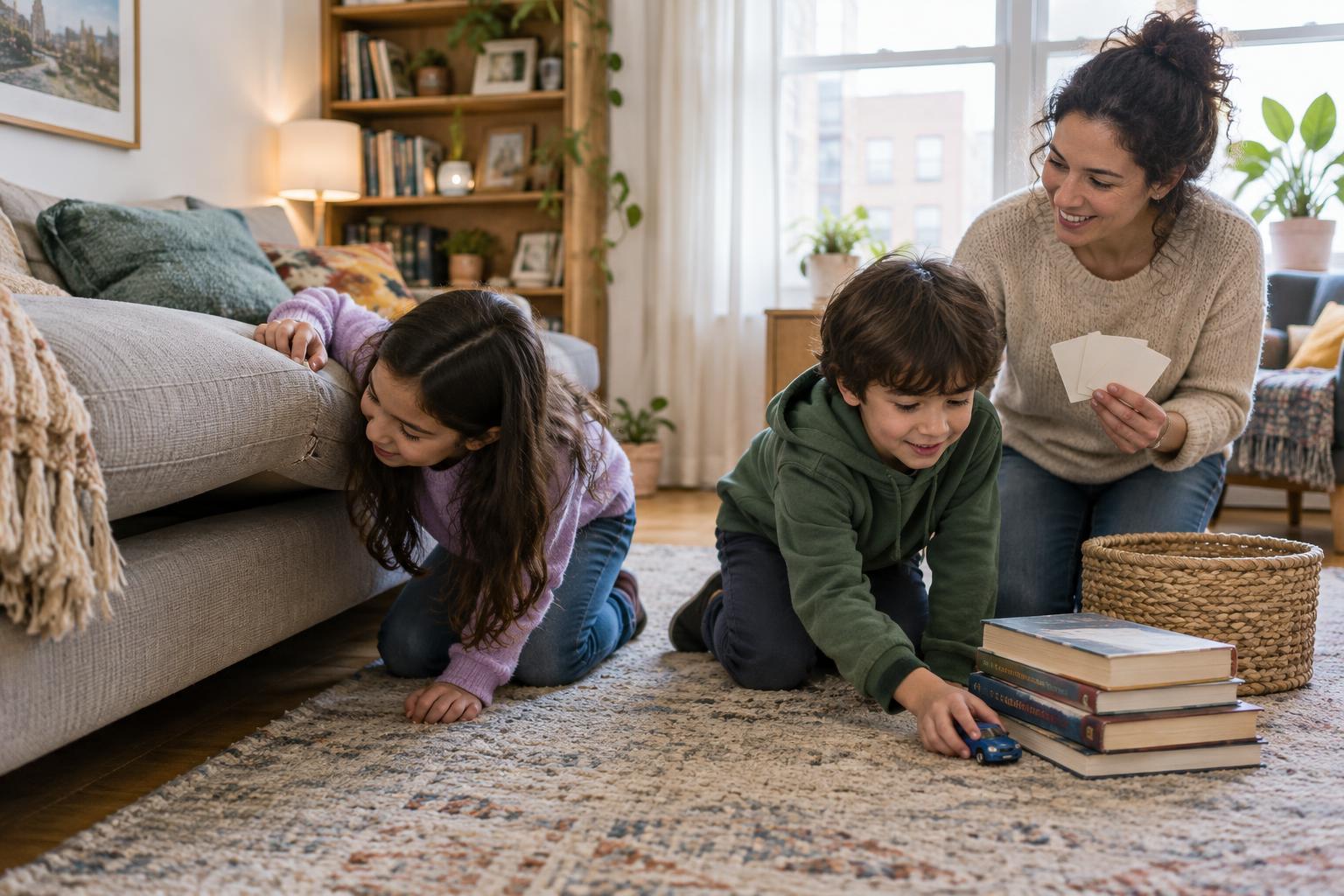
The same objects can support several kinds of play. For a quiet afternoon, ask players to spot items without touching them, then gather to explain their choices. For a more active version, place clues at opposite ends of the approved play area, leaving a clear path between stops. If family members have different ages or preferences, pair them up or give them different jobs: one reads clues, another looks, and another checks items off.
You can also choose a theme from what is already around you. A color hunt asks players to find one object in each selected color. A texture hunt might include something smooth, something soft, and something bumpy. A “daily life” hunt follows objects used in the morning, at mealtimes, and before bed. Themes make it easy to create new rounds without buying or hiding anything.
Finish with a reset everyone can manage
Before the hunt begins, say what should stay in place and what may be carried. Keep breakable items, cleaning supplies, and anything you do not want handled out of the game. If players are collecting objects, use a basket or one designated spot so nothing gets lost. A hunt should feel like an invitation to explore, not permission to empty shelves.
At the end, turn returning objects into one last challenge: “Where does each find belong?” Players can put away the items they carried while you collect any clue notes. Ask which clue was their favorite or which object was hardest to spot. Their answers can help you shape the next round, whether you have five minutes to fill or a longer stretch indoors.