Look for a challenge with a clear starting point
A good puzzle does not have to be easy. It needs to offer a child something they can notice and try. Before choosing one, think about what happens when the pieces come out of the box. Can the child spot a bright object, match a color or find an edge? Those small first steps can make a larger challenge feel inviting rather than overwhelming.
Piece count is a useful clue, but it is not the whole story. A puzzle with fewer pieces can be tricky if much of the picture looks alike. One with more pieces may feel approachable if it has distinct areas, such as a red bus, a blue sky and people wearing different colors. Consider how much of the puzzle a child can work out independently, not just the number printed on the box.
Choose pictures that offer useful clues
Children are often more willing to return to a puzzle when the image interests them. Animals, vehicles, food or a familiar kind of street scene can spark conversation while they work. Interest alone, though, may not be enough: look for clear outlines, varied colors and details that help a child tell one part of the picture from another.
Busy illustrations can be fun if they contain recognizable sections to build separately. A nearly uniform field of grass or sky may be harder to sort, even when the finished picture is appealing. If you can see the completed image before buying or borrowing, imagine spreading out the pieces. Would there be several possible places to begin? Those starting points give a child options when one section feels stuck.
Pay attention to the pieces themselves
A piece should be comfortable for the child to pick up, turn and place. Pieces that are too small or flimsy can add a handling challenge on top of the picture challenge. Sturdy pieces that fit distinctly can make trial and error more satisfying: the child can tell when a match works without having to force it.
If possible, check the puzzle’s condition, especially when borrowing or buying secondhand. Missing pieces can turn a satisfying search into an impossible one. A picture of the completed puzzle on the box or an included guide can also be useful. Keeping that image nearby is not a shortcut that spoils the activity; it is a tool the child can choose to use.
Make room for stopping and starting again
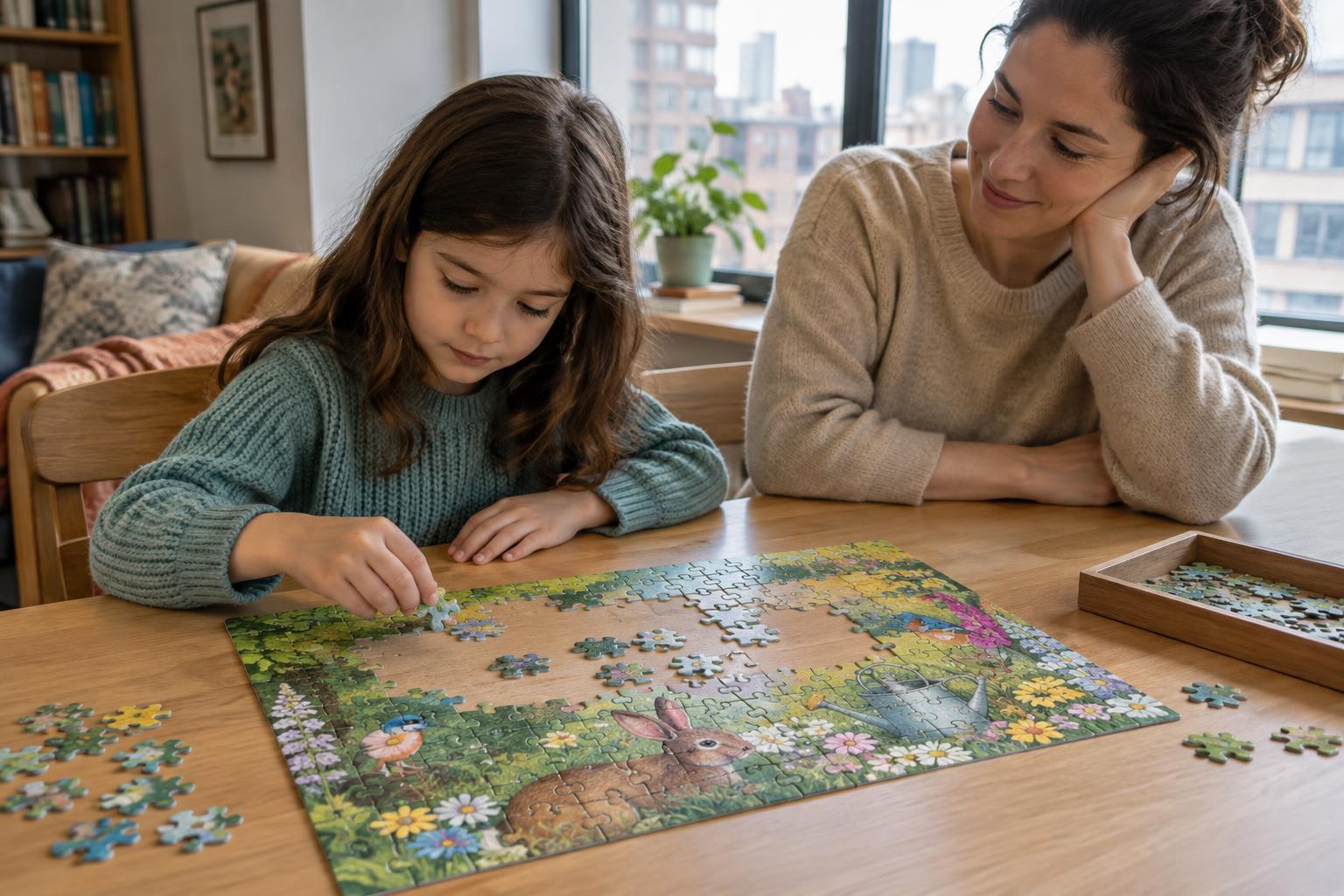
Persistence is easier when a puzzle does not have to be finished in one sitting. In a busy household or a small city apartment, a tray, shallow box lid or piece of cardboard can give the work a temporary home. A small container for loose pieces helps protect progress when the table needs to become a place for dinner or homework.
Try offering one puzzle at a time and spreading its pieces where the child can see them. Too many pieces in a pile can make it hard to find a promising match. If the whole puzzle feels like too much, work on a recognizable section first and leave the rest nearby. Completing one corner or character can give the child a reason to come back later.
Help in ways that leave the solving to the child
When a child gets stuck, an adult can offer a clue without placing the piece. You might ask, “What colors do you see on this piece?” or suggest looking for a matching line in the picture. Sorting a few edge pieces together can also make the next step visible. If help is unwelcome, it is fine to step back; some children prefer to test ideas quietly.
Notice the process rather than treating completion as the only success. Turning a piece, changing a plan or taking a break are all ways of working through a challenge. If a puzzle repeatedly ends in frustration, set it aside without making it a test. Another picture, a different piece style or a smaller project may be a better invitation today. The goal is to make room for the child to think, try and enjoy finding the next fit.