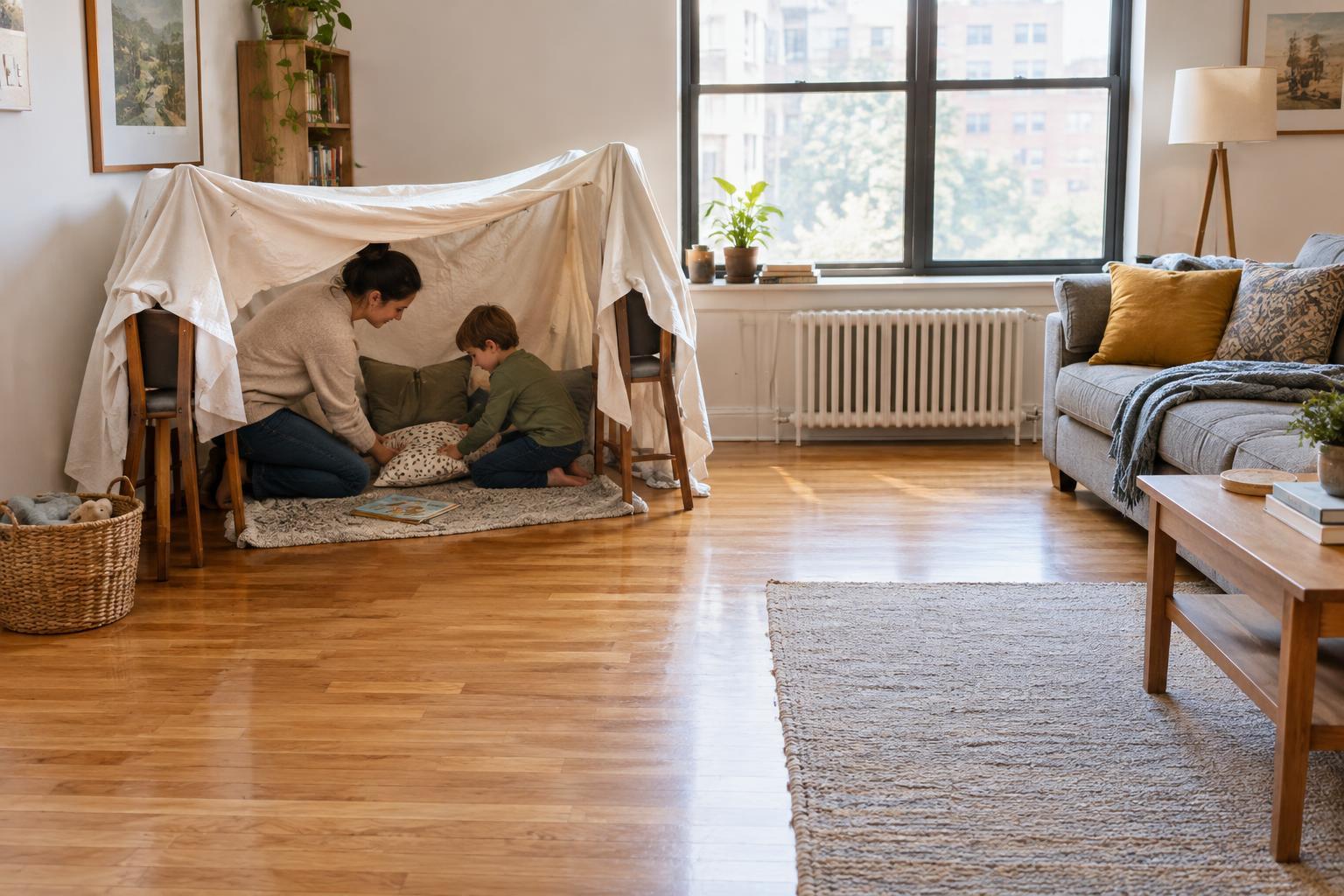
Choose a footprint before you gather supplies
A blanket fort does not need to fill the living room to feel special. Start by choosing a spot that can hold one or two seated children, such as the space beside a sofa or between a sofa and a lightweight chair. Mark its boundaries with a small rug or a couple of floor cushions. That gives everyone a clear picture of where the fort ends and the rest of the room begins.
Before building, walk the route people use to reach the door, bathroom, and kitchen. Keep those paths open, along with access to anything the household needs during the afternoon. If the room is especially tight, consider a fort that shares a wall with the sofa rather than one that stands in the middle of the floor. A compact fort can be just as inviting when there is enough room inside to sit, turn a page, and stretch out a little.
Build with a short, lightweight supply list
Choose two or three supports that are already in the room: a sofa back, sturdy chairs, or the side of a low table. Drape a sheet over them for the roof. A sheet is often easier to position than a thick blanket, and it lets some light through. If the roof slips, try tucking an edge into the sofa cushions or using a few soft clips where children will not bump into them. Avoid stacking furniture or placing heavy objects overhead to hold the fabric in place.
For the floor, use one blanket or mat and a few cushions rather than every pillow in the home. Keep the entrance wide enough for children to get in and out comfortably, and leave part of the fort open for airflow and visibility. Battery-powered lights can add a cozy glow, but they are optional; daylight or a nearby room lamp often works well. Keep fabric away from heaters, lamps, and other warm fixtures.
Give the fort one purpose at a time
A small fort works best when the activity inside has a small footprint, too. Set it up as a reading nook with a short stack of books, a pretend campsite with a stuffed animal or two, or a quiet place to listen to a story. If children want to turn it into a shop, spaceship, or train, let them choose a few props from a single basket. The imaginary setting can change without rebuilding the whole structure.
It helps to keep snacks, paint, and anything likely to spill outside the fort. That is not a rule against messy play; it simply makes this particular activity easier to pack away. An adult can check the setup during play, especially if younger children are joining in or the supports have shifted. When the roof starts to sag, pause and adjust it rather than letting the game continue under unstable furniture.
Make setup and cleanup part of the game
A fort is easier to welcome on a busy day when everyone knows how long it will stay up. Try framing it as a morning reading spot or an after-dinner hideaway rather than an indefinite addition to the room. If you need the floor back by bedtime, say so before the first sheet goes up. Children can still enjoy the project when its ending is predictable.
Keep supplies in one bag or basket, then reverse the building steps at cleanup time: props first, cushions next, roof last. Children can return books and stuffed animals while an adult folds fabric or moves the furniture back. A quick check for clips tucked into cushions helps prevent surprises later. If the fort is popular, take note of which setup worked so the next one requires less rearranging.
Leave room for the rest of the household
The most useful small-space fort is one that can coexist with ordinary life. Someone should still be able to sit on the sofa, cross the room, or put down a bag without dismantling the play area. If that is not possible, shrink the fort: use one chair instead of two, make a lower roof, or trade the structure for a sheet draped over a table that is not needed for meals.
You can also invite children to help solve the space puzzle. Ask which walkway must stay clear and which cushions they truly need. Those choices give them ownership of the fort while respecting everyone who shares the room. When the blankets come down, the living space returns to normal—but the fort can be rebuilt another day with the same few supplies.