Start with the music you already have
You do not need a collection of instruments to make music as a family. Voices, hands, feet, and everyday objects offer plenty to explore. The easiest place to begin is with a song someone already knows. Sing it once as usual, then invite everyone to change one thing: make it slower, whisper a verse, clap on a repeated word, or pause just before the ending. A familiar tune gives children a comfortable starting point, while the small changes keep it playful.
If nobody feels like singing a whole song, try a call-and-response game. One person makes a short sound or rhythm, and everyone else echoes it. A call might be two claps and a hum, a silly syllable, or a gentle tap on a knee. Take turns leading without worrying about perfect copies. For children who would rather listen at first, joining in can be as simple as choosing whose turn comes next.
Find rhythms around the house
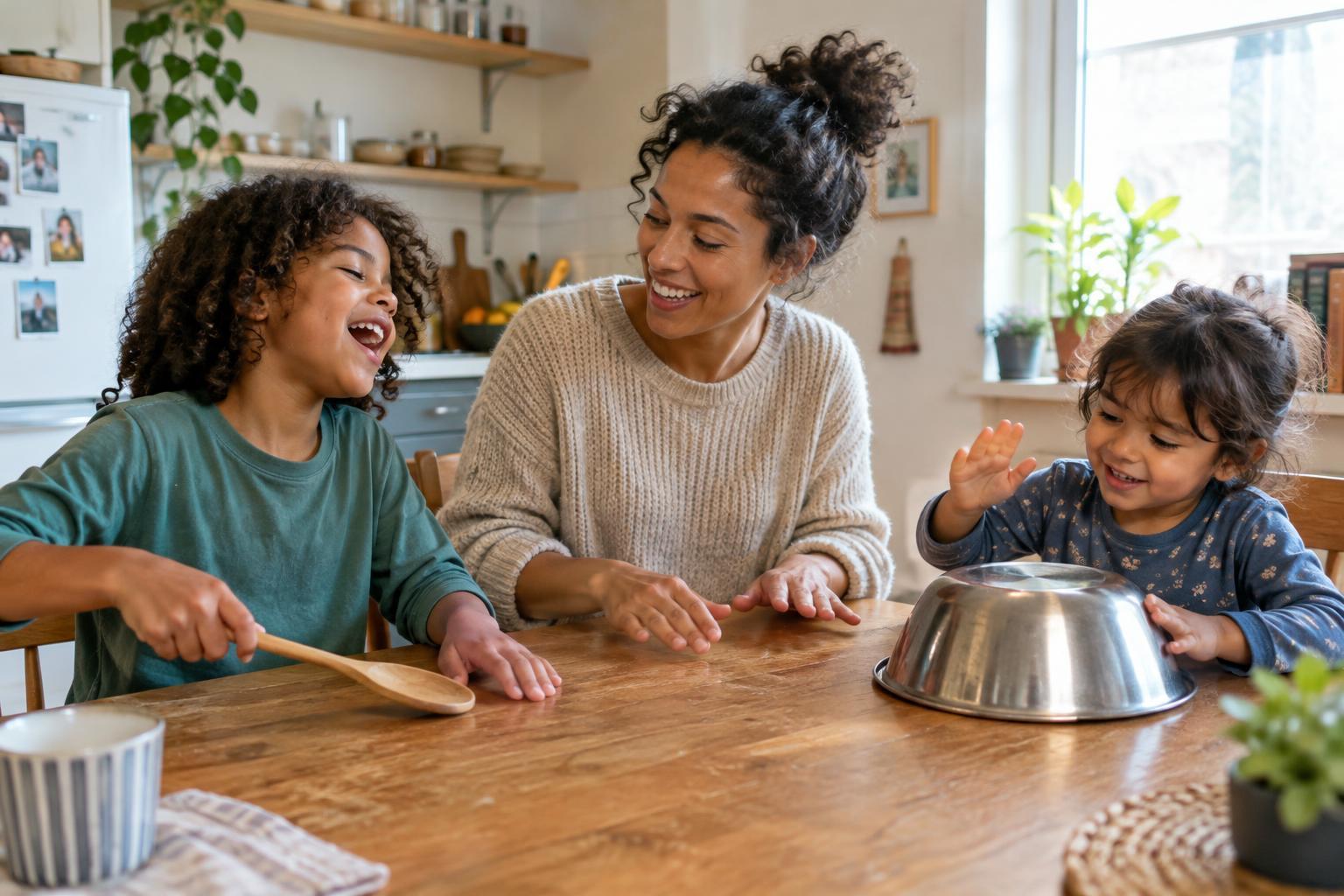
Look for sounds in items you already use: a wooden spoon tapped lightly against a mixing bowl, fingers brushing a cardboard box, or dry pasta shaken in a sealed container. Test each sound together and give it a name, such as a soft swish or a bright tap. Then choose two sounds for a tiny family rhythm: tap-tap, pause, swish. Repeating a simple pattern can be satisfying even when it lasts only a minute.
Keep the setup manageable. Check containers before handing them to children, avoid loose small items with anyone who might put them in their mouth, and set aside objects that could break or have sharp edges. You can also make a quiet version for apartment living: tap fingertips on a pillow, rub palms together, or pat thighs instead of using the floor. A clear sound level—such as “soft enough to hear each other talk”—helps the activity stay enjoyable for everyone nearby.
Let movement become part of the song
Music does not have to happen while everyone sits still. Put on a song you already enjoy, or sing one yourselves, and invent a movement for its beat. March in place, sway from side to side, reach up on a high note, or freeze whenever the singing stops. In a small room, keep the movements compact: seated shoulder rolls and hand waves work just as well as big steps.
Try letting each person add one move to a short sequence. A grown-up might start with two claps; a child adds a turn; someone else finishes with a wave. Repeat the sequence together, then change it when the group is ready. There is no need to correct how anyone moves. The fun is in noticing one another’s ideas and making room for different ways to participate, including watching, humming, or keeping the beat from a chair.
Turn everyday moments into musical games
A music activity can fit into a transition rather than becoming another event to plan. While putting away toys, sing the names of the things going back on the shelf. During a wait for dinner, trade short humming patterns. On the way out the door, make up a walking chant about what you need to bring. These games work best when they stay optional and brief; if the moment is rushed, a single silly line may be enough.
Stories offer another easy opening. Read a favorite book aloud and choose a sound for something that repeats, such as footsteps or rain. Invite a child to make that sound whenever it appears. You can also tell a made-up story in which each person contributes one noise: a knock for the door, a whoosh for the wind, or a soft patter for an imaginary walk. The sounds do not have to be realistic. They simply give everyone a way into the story.
Keep it playful and easy to repeat
The best family music game is often the one you can start and stop without much preparation. Keep a few favorites in mind—a call-and-response rhythm, a quiet tapping pattern, and one song with actions—so you can choose what fits the space and the group’s energy. If an idea loses its appeal, switch leaders, change the speed, or end on a final shared sound.
There is no performance to get right. Some days the family may build a long, noisy song; other days, music together might mean humming while you tidy the table. Listening to one another, taking turns, and enjoying the sounds you can make right now are reason enough to begin.