Make the numbers mean something
A child may happily chant “one, two, three” while pointing to a pile of blocks, but saying the words in order is different from counting the blocks. Counting becomes more meaningful when a child pairs one number word with one object and notices that the last number tells how many are in the group. Play offers plenty of chances to explore those ideas without asking a child to sit still for a lesson.
Start with a few objects that are easy to move, such as toy cars, large blocks, or plastic cups. Slide each one into a new spot as you count it together: “One car, two cars, three cars.” Then ask, “How many cars are parked?” If your child wants to count again, let them. Moving the objects makes it easier to see which ones have already been counted, and repeating the game is often part of the fun.
There is no need to correct every mixed-up number word. You can model a slower count, point to each item, or invite your child to help you check. The aim is to make counting feel useful and interesting, not to turn every answer into a test.
Set up tiny games with toys and household objects
A pretend café can turn counting into a job. Put a few stuffed animals around a table and ask your child to give each guest one cup. Count the cups as they are delivered, then look for anyone who is still waiting. Swap cups for toy plates or blocks if that is what you have. The story gives your child a reason to pay attention to each object rather than rush through a string of numbers.
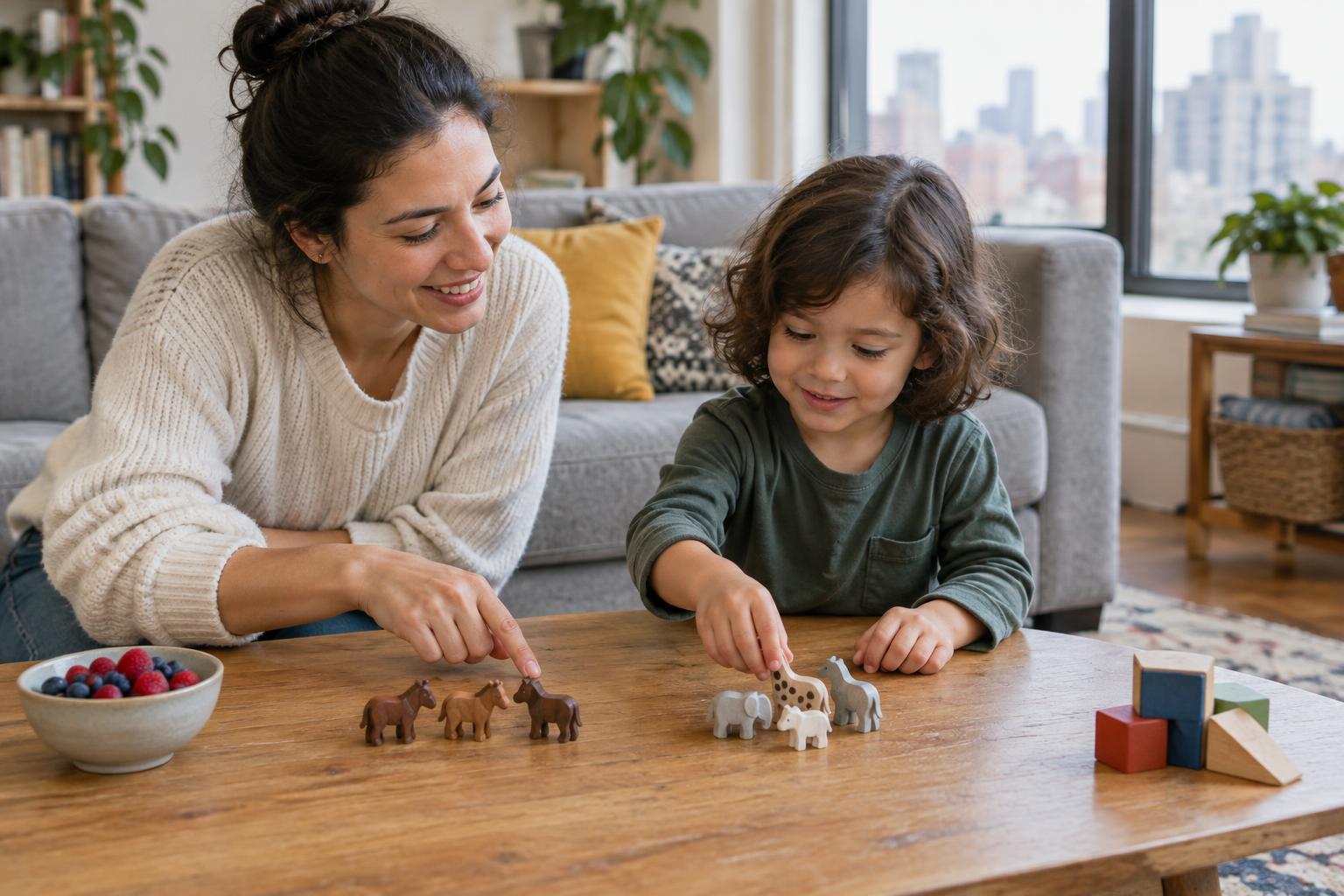
For a quick matching game, draw simple dots on scraps of paper and invite your child to place one button, block, or other safe play object on each dot. Use larger objects if small pieces would be a concern in your household. You can also make two short rows of toys and ask, “Which row has more?” Let your child move the toys into pairs to find out. Seeing an unmatched toy can make “more,” “fewer,” and “the same” easier to talk about.
Keep the groups small enough to handle comfortably, and follow your child’s interest. A child who loves vehicles might count buses at a toy stop; another might prefer lining up pretend picnic food. The particular objects matter less than having a chance to touch, move, and notice them.
Bring counting into everyday movement
Counting does not have to happen at a table. On a walk, you might count three steps to a doorway, four sidewalk squares, or the swings you pass at the playground. Pause when something catches your child’s attention, rather than trying to count every object in sight. In a busy city setting, a short, shared observation is often easier than a long game.
Movement games work indoors, too. Invite your child to put two pillows on the floor for an imaginary river crossing, take three gentle hops, or make a tower with five blocks before knocking it down. Count the actions together as they happen. If the game gets too fast to match a word to each hop or block, slow it down or choose a smaller number.
Daily tasks offer quieter moments. A child can place one napkin at each spot before a meal, count the socks going into a drawer, or help check whether there are enough crayons for everyone at the table. These little jobs show why counting is useful: it helps answer a real question or get something ready.
Ask questions that invite noticing
Once a child has counted a group, try a small change: “We have three blocks. What happens if I add one?” Let them move the new block in and count the group again. Or take one away and ask what they notice. You do not need to press for a quick answer. Handling the objects, making a guess, and checking are all valuable parts of the game.
You can also ask questions without expecting a number every time: “Do we have enough plates for the bears?” “How could we make these two groups the same?” “Did you count that car already?” Questions like these encourage children to look closely and explain what they see. If they would rather build a garage or host a picnic, join the pretend play and bring counting back another time.
The best counting games are easy to start and easy to stop. A handful of toys, a few minutes together, and a question worth answering can do more to make numbers meaningful than a long round of reciting them.