Let the building lead
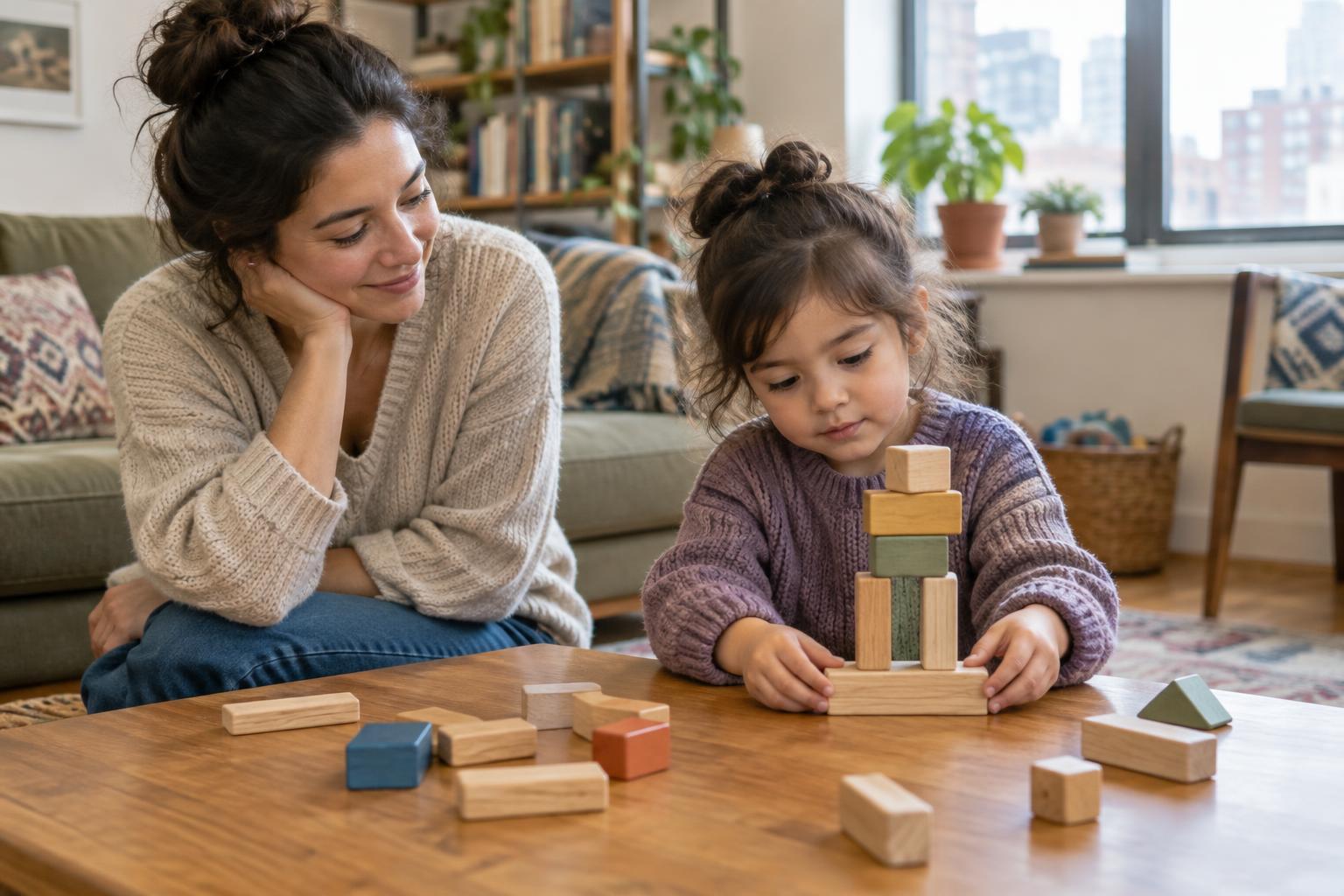
A basket of blocks can become a bridge, a tiny apartment, or a tower that lasts three seconds. The learning is not only in the finished structure. Children can compare shapes, notice balance, make predictions, and change plans while they play. An adult’s most useful contribution is often curiosity rather than a set of instructions.
Start by watching for a moment. Is your child stacking as high as possible, lining up pieces, or making a place for toy figures? A question connected to what they are already doing is easier to answer than a sudden challenge to build something else. You might ask, “Tell me about this part,” or “What are you hoping this piece will do?” If they are deeply absorbed, you can wait. Not every moment of play needs a question.
Ask questions that make room for a test
When a child wants a tower to stand or a bridge to reach across a gap, invite a prediction: “What do you think will happen if this long block goes on top?” Then give them time to try it. A prediction does not have to be right to be useful. The child gets to compare an idea with what actually happened.
Questions that begin with “What could we try?” leave several possible answers. For a wobbly tower, ask, “What might make the bottom steadier?” For a ramp, try, “How could we make the car travel farther?” For a roof that keeps sliding off, ask, “Is there another way to place these pieces?” Keep the questions short and tied to materials the child can move. If they want a turn without talking, let the experiment do the answering.
Treat a tumble as information
A fallen structure can feel frustrating, especially when a child has worked on it for a while. Before suggesting a fix, acknowledge the feeling: “You worked hard on that tower. It fell down.” Then pause. They may want to rebuild immediately, take a break, or turn the fallen pieces into something new.
If they are ready to keep going, help them notice one detail rather than explaining the whole collapse. Ask, “Which part moved first?” or “Did it fall the same way as last time?” They can change one thing, such as widening the base or moving a heavy piece lower, and see whether it makes a difference. If you rearrange everything yourself, the structure may stand, but the child loses the chance to test their own idea. Offer hands-on help when invited or when the task needs another pair of hands.
Keep the challenge playful and manageable
You do not need a large set or a special project to explore building. Try making two towers with different bases, spanning a small gap between books, or building a shelter for a toy. Ask, “What’s different about these two?” or “How could your toy get inside?” Familiar objects can add a purpose to the building without turning play into a lesson.
For younger children, a choice between two blocks may be more inviting than a broad question. An older child might enjoy testing how many pieces a bridge can hold, then changing its design. Follow the child’s interest and adjust the challenge if it becomes discouraging. There is no need to keep rebuilding the same tower if they would rather make a road.
At the end, you can reflect on the process without judging the result: “You tried a wide bottom, and the tower stood longer,” or “You changed the bridge after the car got stuck.” Specific observations show that testing, noticing, and trying again count as part of the fun. Then leave room for the next idea—whether it is another careful design or the satisfying crash of a tower built to fall.