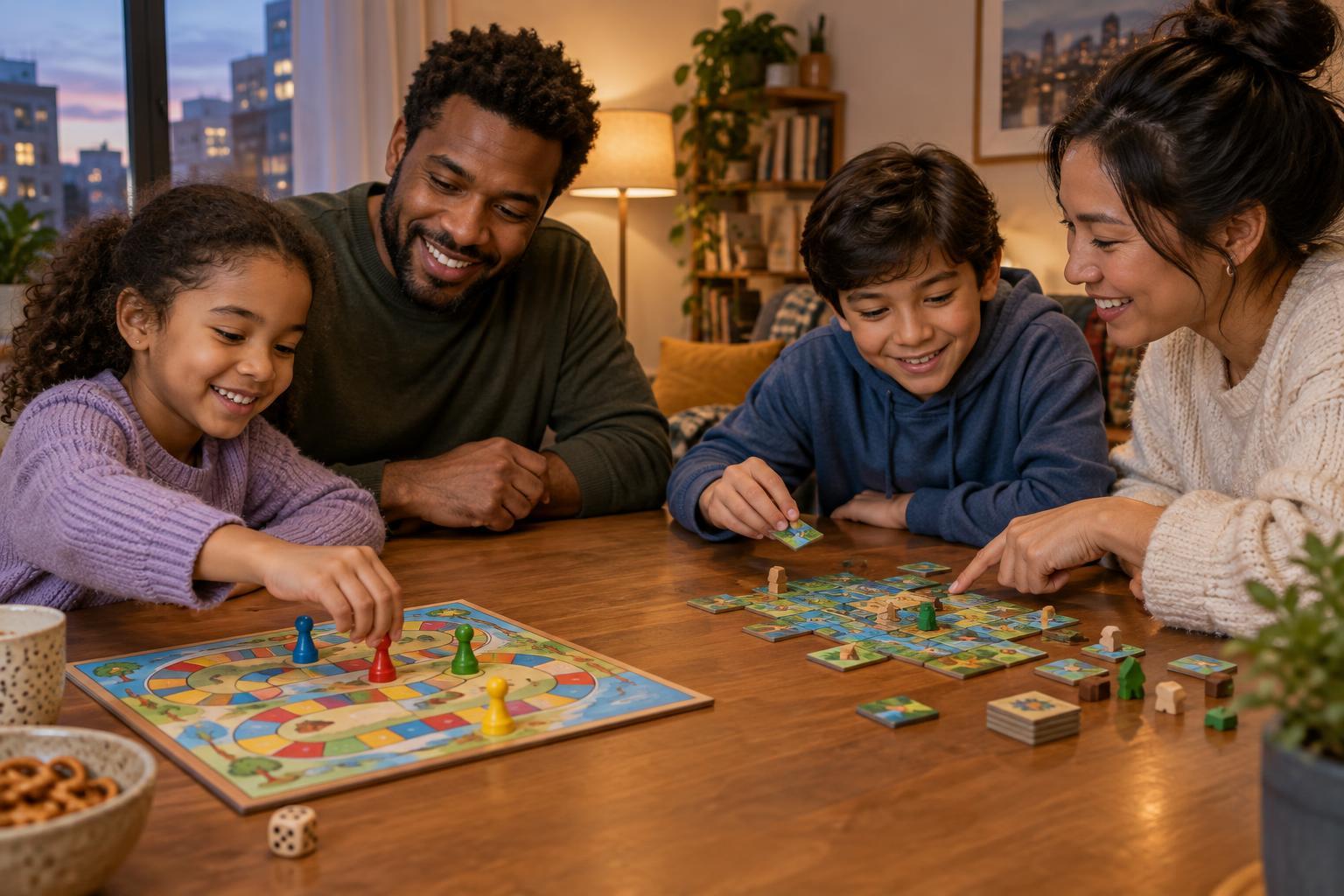
Start with the experience you want
“Board game” describes a format, while “cooperative game” describes how players work together. A cooperative game can be a board game, a card game or something you invent with paper and pencils. For family-night planning, the useful choice is usually between playing against one another and playing toward a shared goal.
Competitive games can bring suspense, playful rivalry and the satisfaction of making your own choices. Cooperative games give everyone a reason to talk, plan and celebrate together. Neither style is automatically better for families. The right one depends on who is at the table, how much time you have and what kind of evening you hope to share.
When friendly competition fits
Choose a competitive game when your group enjoys taking turns, making independent decisions and cheering for a surprising comeback. A short game with simple rules can be especially handy after dinner: everyone gets a chance to play without committing the whole evening. If players want another round, you can start fresh.
Think about what happens between turns. A game may sound exciting but feel slow to a younger player who has to wait while others count points or consider many options. Look for games in which turns move along, or give waiting players a small job, such as handing out cards or checking whose turn is next. For mixed ages, a little luck can keep the outcome less predictable without requiring anyone to hold back.
Before you begin, agree on the basics: whether adults will offer hints, whether players may change their minds during a turn and when the game will end. A loss can be disappointing, especially late in the day. Keeping the focus on memorable moves rather than the final score makes it easier to enjoy the round and put the box away.
When a shared goal fits better
Cooperative games are worth trying when players want to solve a problem together or when a head-to-head contest does not sound relaxing. The group might collect items, build a path or complete a challenge before the game ends. Because everyone is working toward the same outcome, it is natural to ask, “What could we try next?”
Working together does not mean every decision will be easy. One confident player may start directing everyone else’s turns. To make room for each voice, let the person whose turn it is choose after hearing suggestions, or rotate who reads the next card. If the game has a complicated strategy, save explanations for moments when they are useful rather than giving a long lesson at the start.
A cooperative game can still end in a group loss. If your family prefers a gentler finish, choose a game that allows another attempt, or treat the first round as a chance to learn how it works. You can also make your own shared challenge: set a timer and build the tallest stable structure you can from blocks, cups or folded paper.
Match the game to your space and schedule
Family night does not require a large table or an uninterrupted evening. In a small apartment, a card game, a compact board or a tray for pieces may be easier to manage than a game that spreads across the floor. If you need to clear the table for another activity, check whether a round can finish quickly or pause without losing everyone’s place.
Setup and cleanup matter, too. A game with many tiny pieces may be fun on a quiet weekend but frustrating on a crowded weeknight. Keep a simple option within reach for evenings when everyone has limited energy. If players have different ages or interests, offer two choices and let the group pick one. The goal is not to find a game that meets every preference perfectly; it is to make getting started feel easy.
Try both and keep what works
You do not have to commit your family to one style. Try a competitive game one night and a cooperative one the next. You might even pair a short round of each: start with a shared challenge to settle in, then play a quick contest if everyone wants one. Ask afterward what players liked—the teamwork, the suspense, the funny mistakes or simply having time together.
Notice when the evening feels ready to end. Stopping after one enjoyable round often works better than pushing through another when attention is fading. A good family-night game is not necessarily the most elaborate one on the shelf. It is the one your group can begin, enjoy and finish together tonight.